
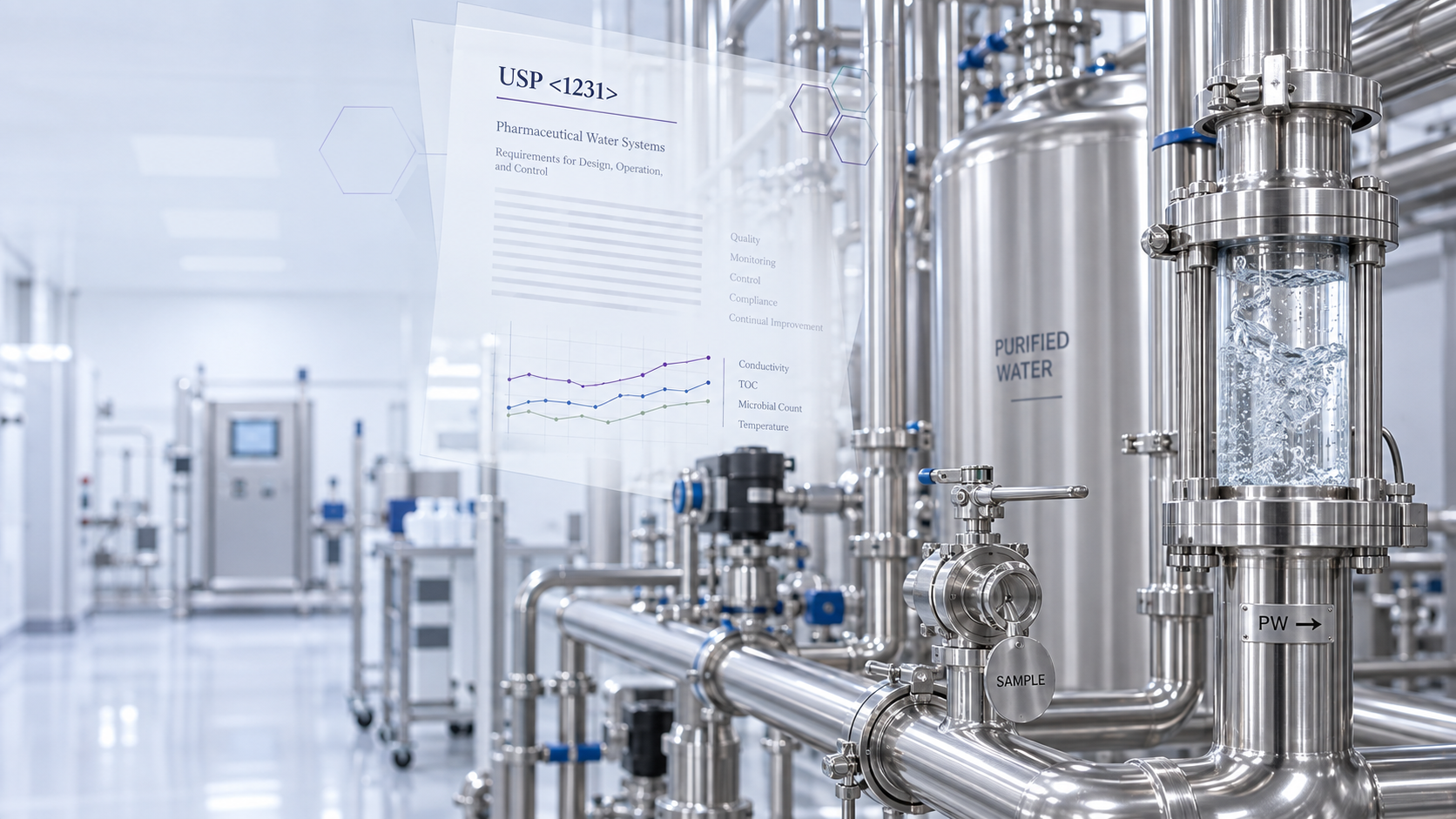

USP <1231> Is Changing: Is Your Pharmaceutical Water Program Ready?
Pharmaceutical water systems rarely fail all at once. More often, the warning signs appear gradually: a shift in total organic carbon, intermittent conductivity results, recovery of a recurring organism, an increase at one point of use, or a sample that may not accurately represent the water entering production.
That is why the proposed revision to USP General Chapter <1231>, Water for Pharmaceutical Purposes, deserves attention from pharmaceutical manufacturers, 503A and 503B compounders, biotechnology companies, and healthcare facilities that prepare sterile or nonsterile products.
USP <1231> has long provided a framework for the design, operation, monitoring, and control of pharmaceutical water systems. The revision does not simply focus on obtaining a passing test result. It reinforces a broader principle: water quality must be understood and controlled across the system, from its source and treatment process to its storage, distribution, sampling, and use.
What is changing in USP <1231>?
USP published an in-process revision in Pharmacopeial Forum 52(1). USP has indicated that the revision is anticipated to be published in September 2026 and become official on April 1, 2027. Until the final text is published, organizations should treat the available content as a proposed revision and confirm the requirements and effective date against the official USP–NF.
The proposed changes address several practical areas that can affect a pharmaceutical water control strategy.
1. Greater emphasis on representative sampling
A laboratory result is useful only when the sample represents the water used in the process.
The proposed revision clarifies the advantages of online measurement for total organic carbon under USP <643> and water conductivity under USP <645>. Where testing is performed offline, the sampled water must still be representative of the water used in production.
This places attention on questions that are sometimes overlooked:
- Is the sample collected from the actual point of use or from a more convenient location?
- Is the outlet flushed before sampling, and does that practice represent how the outlet is used in production?
- Can the sampling container, cap, tubing, or handling technique affect the result?
- How much time passes between collection and testing?
- Are transportation and storage conditions defined and justified?
- Does the sampling procedure distinguish between a system sample and a process-use sample?
A result can be analytically valid while still being operationally misleading. If the sample does not represent the water used by manufacturing, a passing result may provide false confidence—and an unexpected result may lead investigators in the wrong direction.
2. Online TOC and conductivity receive clearer recognition
Online monitoring can provide a more continuous view of system performance than periodic grab samples. It may reveal short-duration events, sanitization recovery, progressive drift, or changes associated with operating cycles that routine offline sampling could miss.
The proposed language encourages consideration of online TOC and conductivity, but installing an online instrument is not a substitute for a scientifically designed monitoring program. The organization still needs to establish:
- Appropriate instrument locations
- Calibration and maintenance controls
- Data review responsibilities
- Alert and action levels
- Alarm-response procedures
- Data-integrity controls
- A method for connecting chemical data with microbial trends and system events
Facilities relying on offline testing should be prepared to explain why the selected points, frequencies, collection practices, and hold times produce representative information.
3. Clarification of offline conductivity testing
The proposal clarifies that when offline conductivity testing is preferred, testing may begin at Stage 2 without first performing Stage 1.
This is a technical clarification, but it is also a useful reason to review laboratory procedures. An SOP should clearly define which conductivity pathway is used, how temperature and sample handling are controlled, what acceptance criteria apply, and what happens when a result does not meet the applicable requirement.
Organizations should verify that their forms, worksheets, laboratory systems, and training materials agree with the procedure actually performed.
4. A clearer distinction between the TOC target limit response and the true limit
The proposed revision explains the difference between what is commonly called the TOC “target limit response” and the true limit. It also emphasizes the use of USP Reference Standards.
This matters because suitability testing is sometimes treated as a routine instrument exercise rather than evidence that the system can adequately detect and respond to specified organic carbon challenges. Laboratories should review how system suitability is prepared, calculated, documented, and investigated.
A complete review should include:
- Reference-standard control
- Preparation and expiration of standards
- Reagent water suitability
- Instrument calibration and qualification
- System-suitability calculations
- Data review and audit trails
- Handling of atypical or failing responses
5. Added substances require a risk-based approach
The proposed chapter adds language regarding substances intentionally added during water-system operation. It calls for risk assessment addressing their use, reduction, and detection, when appropriate.
This may apply to chemicals used in pretreatment, regeneration, sanitization, pH adjustment, or other system operations. The control strategy should establish whether an added substance—or a residue, reaction product, or degradation product—could remain in the water and affect its intended use.
The assessment should be based on the substance, system design, removal mechanism, detection capability, water use, product risk, and affected patient population. A statement that the system was flushed may not be sufficient without defined parameters and supporting evidence.
6. Ozone must be reduced before the water is used
Ozone can be an effective means of controlling microbial proliferation in a pharmaceutical water system. However, residual ozone can interfere with manufacturing processes, product quality, and some analytical or microbiological tests.
The proposed revision clarifies that ozone used for sanitization should be reduced below the limit of detection before the pharmaceutical water is used.
Facilities using ozonated systems should confirm that their procedures define:
- Where ozone is generated and measured
- How ozone destruction or removal is verified
- The analytical method and its detection capability
- The conditions required before returning the system to service
- The records demonstrating acceptable post-sanitization recovery
This is particularly important when water is released for use based on elapsed time rather than a documented measurement.
7. Additional clarification for sterile packaged waters
The proposed revision clarifies that “nominal container volume” refers to the volume the container is intended to hold, rather than the volume actually filled. It also discusses the evaluation of organic components when a sterile packaged-water TOC result falls between defined limit responses.
For manufacturers of sterile waters and other affected products, this may require review of calculations, specifications, investigation procedures, and the scientific approach used to identify and evaluate potential organic contributors.
8. Nitrosamines enter the water-system conversation
The proposed revision adds a subsection addressing nitrosamines. USP describes the risk from nitrosamines or their precursors in pharmaceutical water as low, while still recognizing the need for a control strategy and risk-based evaluation when appropriate.
This does not mean every facility needs to add routine nitrosamine testing to its water program. It means the risk should be considered in context rather than automatically dismissed or converted into unnecessary testing.
A meaningful assessment may consider source-water information, treatment chemicals, system materials, regeneration or sanitization practices, known precursors, the intended water use, and the product-specific control strategy.
What is not changing?
The revision should not be interpreted as replacing good water-system fundamentals. A robust program still depends on sanitary design, controlled operation, qualified sampling, appropriate chemical and microbiological methods, meaningful alert and action levels, organism identification, trend review, maintenance, sanitization, and effective investigations.
USP <1231> is a general information chapter. Chapters numbered above <1000> are generally informational unless they are made applicable through a monograph, another compendial requirement, a regulatory commitment, or an organization’s own procedure. However, regulators may still look to recognized scientific guidance when evaluating whether a pharmaceutical water system is appropriately designed and controlled.
The practical question is therefore not only, “Is this chapter mandatory?” It is, “Can our data demonstrate that the water system remains in a state of control?”
Is your water program ready?
The proposed revision provides an opportunity to perform a focused gap assessment before the anticipated official date. Quality, Engineering, Manufacturing, and the microbiology and chemistry laboratories should review the program together.
Consider asking:
- Do our sampling locations and practices represent the water actually used in production?
- Have we justified online versus offline TOC and conductivity monitoring?
- Do our conductivity procedures reflect the appropriate compendial pathway?
- Are TOC system suitability and USP Reference Standards properly controlled?
- Have we assessed substances added during treatment, regeneration, or sanitization?
- If ozone is used, do we verify its reduction below the method’s detection limit before use?
- Are alert and action levels based on system performance rather than copied from another facility?
- Do we trend chemical and microbial results together with maintenance and sanitization events?
- Do we identify recurring or potentially objectionable microorganisms?
- Can an investigation determine whether an excursion is isolated, sampling-related, or system-wide?
A passing result is only one part of water-system control
Routine testing remains essential, but individual results cannot tell the entire story. A mature pharmaceutical water program evaluates where the sample came from, how the result compares with historical performance, what organisms are being recovered, whether system conditions have changed, and whether the data reveal a developing loss of control.
Preparing for the USP <1231> revision should not be a document-only exercise. It is an opportunity to determine whether the monitoring program produces representative, timely, and actionable information.
PlumGXP supports pharmaceutical, biotechnology, medical-device, compounding, and healthcare organizations with water-system qualification and routine monitoring, onsite sampling, USP <643> TOC, USP <645> conductivity, microbial enumeration, bacterial endotoxin testing, microbial identification, trend evaluation, and investigation support.
Is your pharmaceutical water program ready for the next inspection—and the next system change? Talk with PlumGXP about building a program that looks beyond an isolated result and helps demonstrate continued control.